
Generative Canvas
Inventing the Agentic Interface — The Blueprint Behind Generative Patterns Now Shaping Slack and Salesforce.
Generative Canvas is Salesforce’s first AI-assembled workspace—an adaptive interface that builds itself around user intent, data, and context. I led the design vision and partnered with product and engineering to define how the system interprets intent, orchestrates data, and generates the right surfaces automatically. We designed, built, and shipped the first working prototype in just five months.
The patterns introduced here became foundational to Salesforce’s agentic UX strategy and directly influenced Slack’s emerging agentic OS direction, showcased at Dreamforce 2025.


A Smarter Starting Point
We designed the Canvas experience to begin with a simple, conversational input—typed or spoken. From there, the system interprets intent, identifies what the user needs next, and assembles a tailored workspace in seconds. This shifted the model from "search and navigate" to "describe what you need, and the system builds it."
I pushed hard for this interaction model because it unlocked the entire generative workflow architecture that followed.

Personalized for Your Workday.
We built Canvas to adapt to each individual—pulling from role, responsibilities, relationships, upcoming meetings, and work history. Over time, it learns how each person operates and adjusts the content, insights, and workflows it assembles.
I led the UX architecture for this personalization layer, ensuring AI could create a meaningful "start your day" experience grounded in the right signals.

Context Assembled Across Your Ecosystem
Canvas brings together CRM data, documents, calendar events, customer history, communications, and external signals into a unified, AI-curated workspace. Our goal was to eliminate the need for users to dig for information by having the system surface exactly what mattered.
I partnered with engineering early to shape how these heterogeneous data sources could be fused in real time to support dynamic UI generation.

Insights Delivered Instantly
Rather than navigating dashboards or reports, users receive insights directly inside the canvas—trends, anomalies, risks, opportunities, and AI-generated recommendations. These analytics dynamically reshape themselves based on intent and data patterns.
I drove the strategic decision to make insights contextual and situational, ensuring the canvas always answered, "What should I know, and what should I do next?"

Actionable Output, Ready to Use
Canvas doesn’t stop at assembling context—it helps users act. The system generates summaries, emails, briefs, proposals, and meeting prep documents directly from the data within each canvas.
Working closely with our AI research and engineering partners, I shaped the interaction model for human–agent co-creation, enabling users to refine and publish high-quality content with minimal friction.
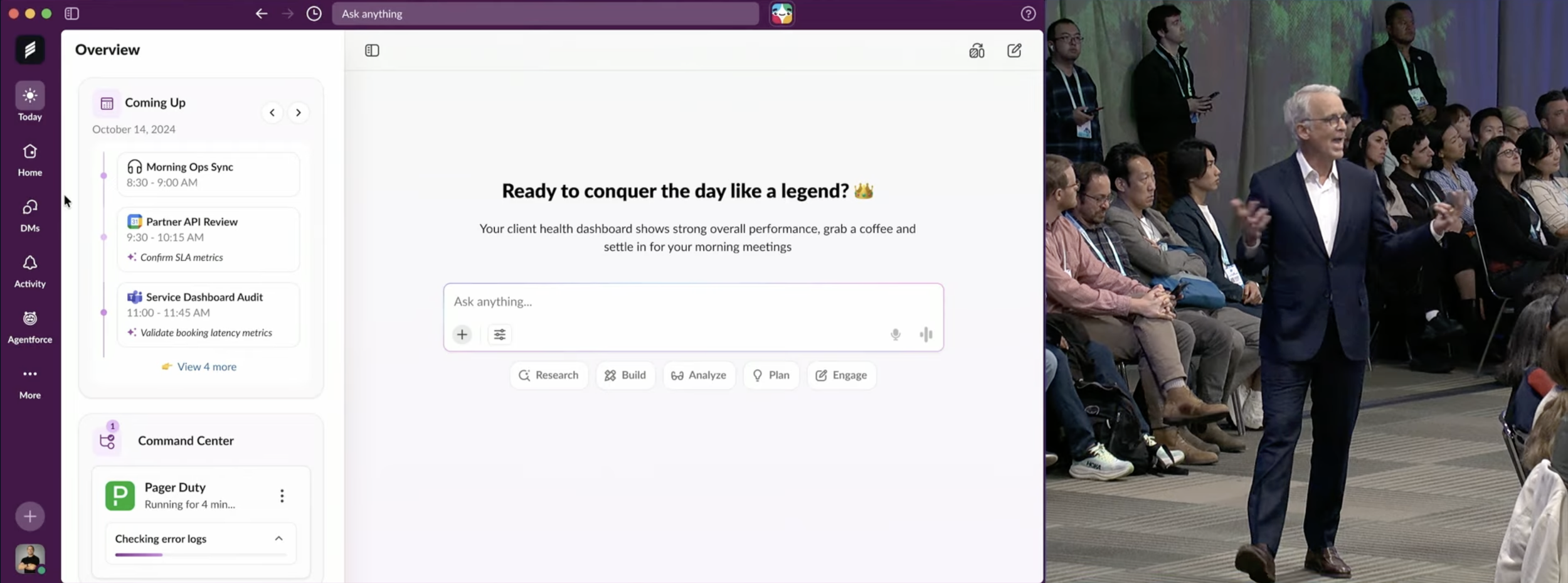
Parker Harris unveiling the “Today View” at Dreamforce 2025. Watch the demo below.
Product Impact
Generative Canvas became a cornerstone for Salesforce’s and Slack’s agentic design direction. It informed generative patterns across Next-Gen Chat, Agentforce, Service, Sales, and Slack’s "start your day" experience highlighted by CTO Parker Harris at Dreamforce 2025.
As design lead, I guided the vision and collaborated closely with product and engineering to deliver the first working prototype in five months and file three patents that established a new design language for agent-driven interfaces.
Slack = The AgenticOS for work
dskfhkdsafhadkhfkdjshfkadshfkladhsfkjlhadsf